

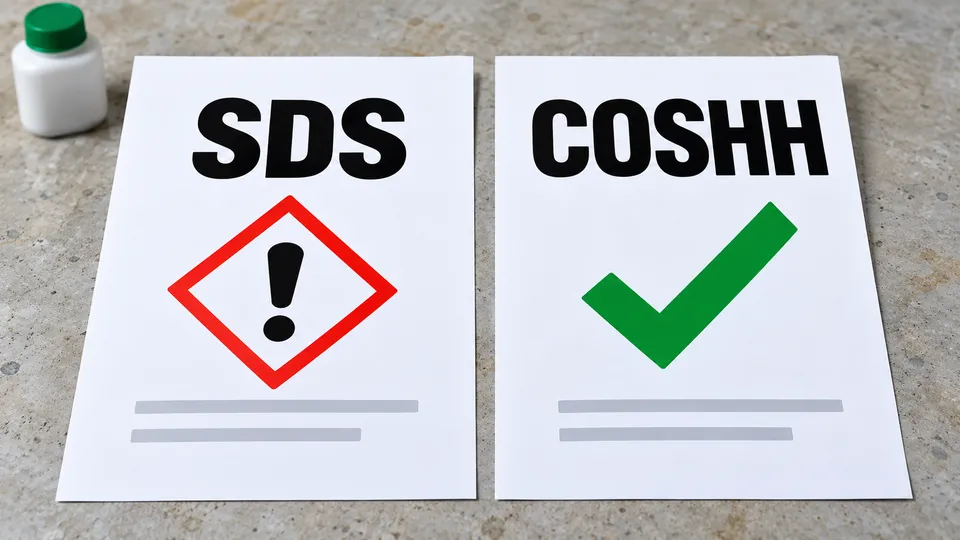
What the safety data sheet provides
For a hazardous chemical product, the supplier SDS can provide classification, hazard statements, composition information, exposure controls, physical properties, storage, first-aid, fire, spill and disposal information. Check that the product and revision match what will be used.
The sheet is written for a range of foreseeable uses. It usually does not know your task, quantity, frequency, duration, work area, ventilation, nearby people or the way different activities interact on your site.
What the COSHH assessment must add
The assessment considers how exposure could occur during the real task: inhalation, skin or eye contact, ingestion or injection where relevant. It considers how often and how long people are exposed, who else could be affected, what controls are already present and what further action is required.
It must also consider hazardous substances created by the process, not only labelled products. HSE gives examples including wood dust from sanding, silica dust from cutting and fumes from welding.
Why copying the SDS is not enough
HSE states directly that a safety data sheet is not a risk assessment. Copying generic PPE or first-aid wording into a form does not decide whether the process can be eliminated, substituted, enclosed or controlled by extraction, nor whether those measures work in the actual location.
The assessor should identify which SDS information is relevant, resolve conflicts with workplace evidence or exposure guidance, and document the task-specific decision.
A practical source-check sequence
Use the source as evidence, then complete the workplace assessment.
- Confirm the exact product or process-generated substance.
- Obtain a current supplier SDS or another appropriate authoritative source.
- Identify classifications, exposure routes, WEL information and emergency information relevant to the task.
- Assess quantity, frequency, duration, people and workplace conditions.
- Consider elimination and prevention before relying on PPE.
- Specify controls, responsibilities, training, monitoring, maintenance and review.
- Record that the named source was checked by the assessor.
Sources
Read the full guidance for more detail.