

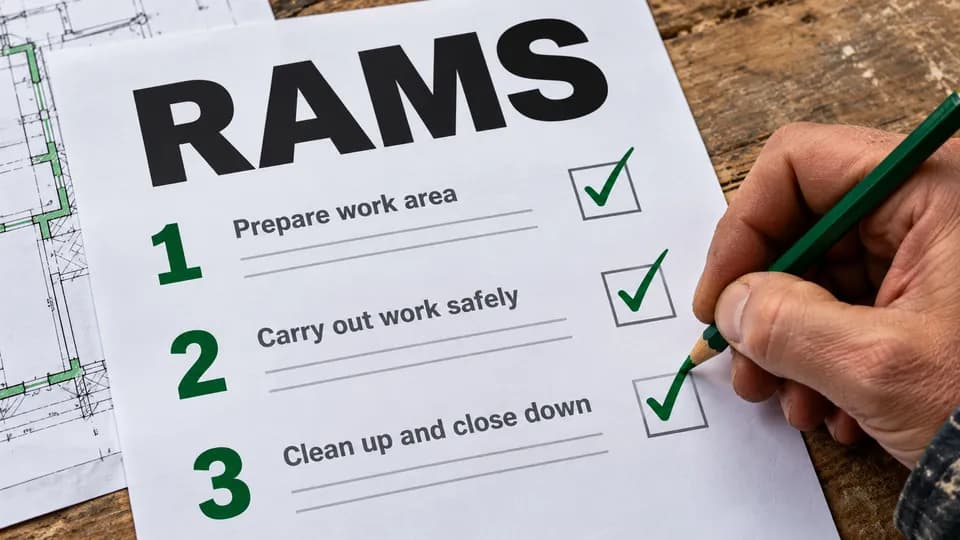
1. Define the work before assessing it
Record what is being done, where, when and by whom. Include the boundaries of the task, the client or principal contractor arrangements, access constraints, nearby work, services, public interfaces and any assumptions that still need confirmation.
A vague scope produces vague hazards and a generic method. If the work changes materially, stop and revisit the assessment rather than stretching the original wording to cover a different job.
2. Identify hazards and who could be harmed
Walk through the job from arrival and setup to completion and demobilisation. Consider routine work, cleaning, maintenance, foreseeable abnormal conditions and interactions with other contractors or members of the public.
Name the people or groups who could be harmed and describe the harm. “Operatives — injury” is usually too weak to support a good decision. The assessment should explain the credible event, such as a fall through a fragile rooflight causing serious injury to the worker below roof level.
3. Select controls in a sensible order
Start by asking whether the hazard can be eliminated. If not, consider substitution, engineering or collective protection, planned systems of work and then PPE as part of the remaining controls. The exact hierarchy and terminology varies by hazard, but PPE should not become the automatic first answer.
Controls must be specific enough to implement. Identify the equipment, standard, capacity, inspection, exclusion zone, competent role or hold point where that detail is needed for the work to be safe.
4. Write the method in the order work will happen
Use numbered, observable steps. Include preparation, permits and isolations before the physical task; identify when controls are installed, checked and removed; and show how the area is left safe.
Cross-check every significant control against the sequence. If the assessment requires edge protection, isolation, ventilation or a rescue arrangement, the method should show when it is established, who checks it and how long it remains in place.
5. Complete supporting arrangements
Record supervision, competence, communication, plant and tool checks, PPE/RPE, welfare, emergency and rescue arrangements, waste controls, environmental limits and relevant permits. Where substances are used or harmful dust, fume, mist, vapour or gas may be produced, decide whether a task-specific COSHH assessment is needed.
6. Review, brief and monitor
A competent person should review the entire document for internal consistency and site relevance. Resolve missing facts before issue, brief the people doing the work, and make sure they can ask questions or report a mismatch.
Monitor the job against the planned method. Review the RAMS after changes, new information, an incident or near miss, evidence that controls are ineffective, or when the planned review point is reached.
Sources
Read the full guidance for more detail.